
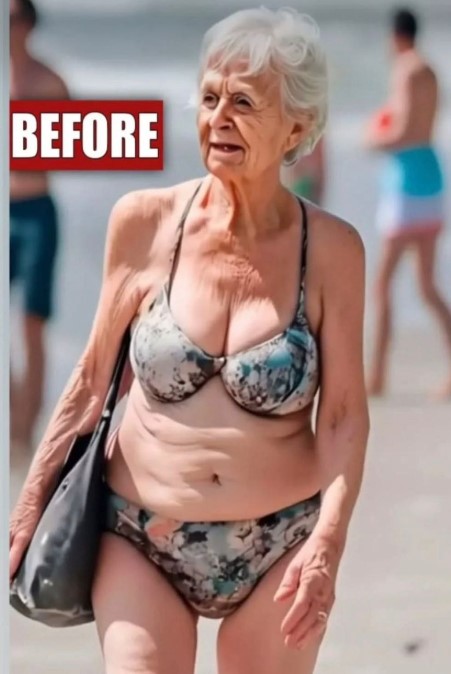
A photo circulating online this week—showing an older woman confidently walking along a beach—has sparked more than viral clicks. It has reignited a growing cultural conversation: the idea that women don’t lose attractiveness with age, but often gain it.
The image, framed as a “before-and-after,” appears at first glance to follow a familiar transformation trope. But many viewers have flipped the narrative entirely. Rather than seeing a “before” in need of improvement, they see a woman embodying something increasingly admired: ease, self-possession, and authenticity.
Psychologists and sociologists say this reaction reflects a broader shift in how attractiveness is defined. While youth has long been treated as the gold standard—especially for women—research suggests that confidence, emotional intelligence, and self-acceptance play a far larger role in perceived attractiveness than smooth skin or a specific body shape.
“As people age, they tend to care less about external validation,” says one social psychologist who studies self-image across the lifespan. “That reduction in self-consciousness often reads as confidence, and confidence is universally attractive.”
There’s also a cultural fatigue with hyper-curated beauty. After years of filters, cosmetic trends, and relentless optimization, many people are responding positively to bodies that look lived-in and real. Wrinkles, softness, and visible signs of age increasingly signal experience rather than decline.
The woman in the photo—whose identity and story are unknown—has become a kind of accidental symbol. Online commenters frequently note her posture, her expression, and the way she occupies space without apology. To many, that presence is the point.
“Older women often know who they are,” wrote one commenter. “That’s magnetic.”
The conversation also touches on power. With age often comes financial independence, clearer boundaries, and freedom from expectations that once shaped how women dressed, behaved, or judged themselves. That autonomy can translate into a form of attractiveness rooted not in being looked at, but in being fully oneself.
While beauty standards have not disappeared, moments like this suggest they are being challenged—sometimes by a single image that refuses to fit the old script.
What the viral photo ultimately reveals is less about transformation and more about perception. As society slowly broadens its definition of beauty, it is becoming harder to ignore a simple truth many women already know: attractiveness doesn’t fade with age—it evolves.
A photograph circulating widely on social media this week has ignited a fresh conversation about aging, body image, and the way images are framed online.
The image shows an older woman walking along a beach in a patterned bikini, carrying a shoulder bag. The photo is overlaid with bold text reading “BEFORE,” while a partially visible lower section suggests an “AFTER” comparison. The framing and labels have led many viewers to assume the image is part of a transformation story—despite no clear evidence of what the “after” is meant to show or whether the images depict the same person at all.
As the photo spread across platforms, reactions quickly diverged. Some users criticized the post as misleading or ageist, arguing that labeling an older woman’s natural appearance as a “before” reinforces unrealistic beauty standards. Others pushed back against the premise entirely, saying the woman appears confident and comfortable, and questioning why her body should be treated as something in need of improvement.

“This is exactly how vague ‘before-and-after’ posts manipulate perception,” said one media literacy advocate online. “They imply a problem without stating one—and let the audience fill in the gaps.”
The image has also been embraced by body-positivity communities, who have reframed it as a celebration of aging visibly and unapologetically. Many commenters praised the woman’s self-assurance and criticized the culture of digital makeovers, filters, and transformation marketing that often targets insecurities—particularly among women.
Experts note that such viral images highlight a broader issue: the lack of context in social media posts. Without information about when, where, or why photos were taken—or whether they’ve been edited—viewers are left to draw conclusions that may not be accurate.
As of now, the origin of the image and the intent behind the “before-and-after” labeling remain unclear. What is clear is that a single photo has once again exposed the power of presentation—and how quickly a moment captured on a beach can turn into a global debate about how bodies are judged, online and off.